Why a Kitchen Lighting Demonstration Matters Before You Renovate
Seeing Is Believing: The Real Value of a Lighting Trial
Anyone who has ever renovated a kitchen knows that the lighting plan often gets treated as an afterthought. You pick the cabinets, choose the worktop, select the tiles, and somewhere near the end you start thinking about where the lights will go. But after spending years helping clients in Glasgow with their kitchen projects, I can tell you that the order should be reversed, or at least given equal weight from the start. A kitchen lighting demonstration is the single most useful step you can take before committing to a full installation. It sounds simple, but seeing actual fixtures running in a real room changes everything.
In a showroom, the effect is immediate. You walk into a space and you feel the difference between a well-lit kitchen and one that has been thrown together with whatever was on sale. That is exactly why a kitchen lighting demonstration in a proper showroom setting is so revealing. You get to stand under the lights, move around, and see how shadows fall across the work surfaces. You can test how the light reflects off the cabinet doors and whether it creates glare on the splashback. These are things you cannot judge from a photograph or a specification sheet.
Understanding the Layers of Kitchen Lighting
Professional lighting design is built on layers. You have ambient lighting, which is the general illumination that fills the room. Then you have task lighting, which is the focused light you need for chopping vegetables or reading a recipe. And finally, you have accent lighting, which draws attention to architectural features or a beautiful piece of cabinetry. A good kitchen lighting demonstration will show you how these three layers work together, and more importantly, how they can be controlled separately.
For example, during the day you might want only the ambient and accent lights on, with the task lighting dimmed or off. In the evening, you might want the under-cabinet lighting turned up while the pendant lights are dimmed to create a softer mood. That is where dimmer switches become essential. They give you the flexibility to adjust the atmosphere without changing the fixture. In a demonstration, you can see exactly how the light changes as you turn the dimmer from one end to the other. It is a small thing, but it makes a huge difference to how the kitchen feels at different times of day.
Why the Showroom Experience Matters
There is a reason why a dedicated showroom is the best place for a kitchen lighting demonstration. In a showroom, the lighting is already designed by people who understand the products. The fixtures are mounted at realistic heights, the colour temperature is set properly, and the space is arranged to show off both the lights and the cabinetry. When you visit a showroom in Glasgow, you are seeing the products in an environment that mimics a real home. That is far more useful than looking at a single pendant light hanging from a warehouse ceiling.
During one of my recent visits to a local showroom, I watched a customer spend over an hour testing different combinations of LED strip lights and recessed lighting under a set of German kitchen cabinets. They brought their own pots and pans to see how the shadows fell on the work surface. That is the level of detail a proper demonstration allows. You cannot get that from a website or a brochure. You need to be in the space, moving around, seeing how the light behaves with real objects.
Choosing the Right Fixtures for Your Kitchen
When you start looking at specific brands, the choices can feel overwhelming. Kichler and Hinkley Lighting are two manufacturers that consistently deliver quality fixtures, but they have very different design languages. Kichler tends toward clean, modern lines, while Hinkley Lighting often incorporates more traditional details and warmer finishes. In a kitchen lighting demonstration, you can see side by side how a Hinkley pendant looks next to a Kichler recessed light. You can compare the beam spread, the colour rendering, and the overall aesthetic.
Crystal chandeliers are another fixture that benefits enormously from a live demonstration. In photographs, they look glamorous, but in real life, the way the light passes through the crystal and scatters across the room is something you have to see in person. The sparkle changes depending on the angle of the light and the time of day. A chandelier that looks perfect in a showroom photo might be too bright or too reflective in your actual kitchen. A demonstration lets you judge that before you spend the money.
Colour Temperature and Energy Efficiency
One of the most common mistakes people make is choosing the wrong colour temperature for their kitchen. Colour temperature is measured in Kelvins, and it determines whether the light looks warm (yellowish) or cool (bluish). For a kitchen, you generally want something in the middle, around 3000K to 3500K, but that depends on the cabinet colour, the worktop material, and the natural light in the room. A kitchen lighting demonstration allows you to test different colour temperatures right there in the showroom. You can see how a warm 2700K light looks against a white German kitchen versus a darker bespoke kitchen made from British design oak.
Energy efficiency is another consideration that becomes clearer in a demonstration. LED strip lights, for example, consume a fraction of the power that halogen strips used to, but the quality of the light varies a lot between brands. Some LED strips produce a flicker that is barely noticeable at first but becomes irritating over time. In a demonstration, you can look for that flicker and compare different products. You can also see how the light holds up at different dimmer levels. Not all LEDs dim smoothly, and you want to know that before you install them.
Under-Cabinet and Recessed Lighting: The Workhorses of the Kitchen
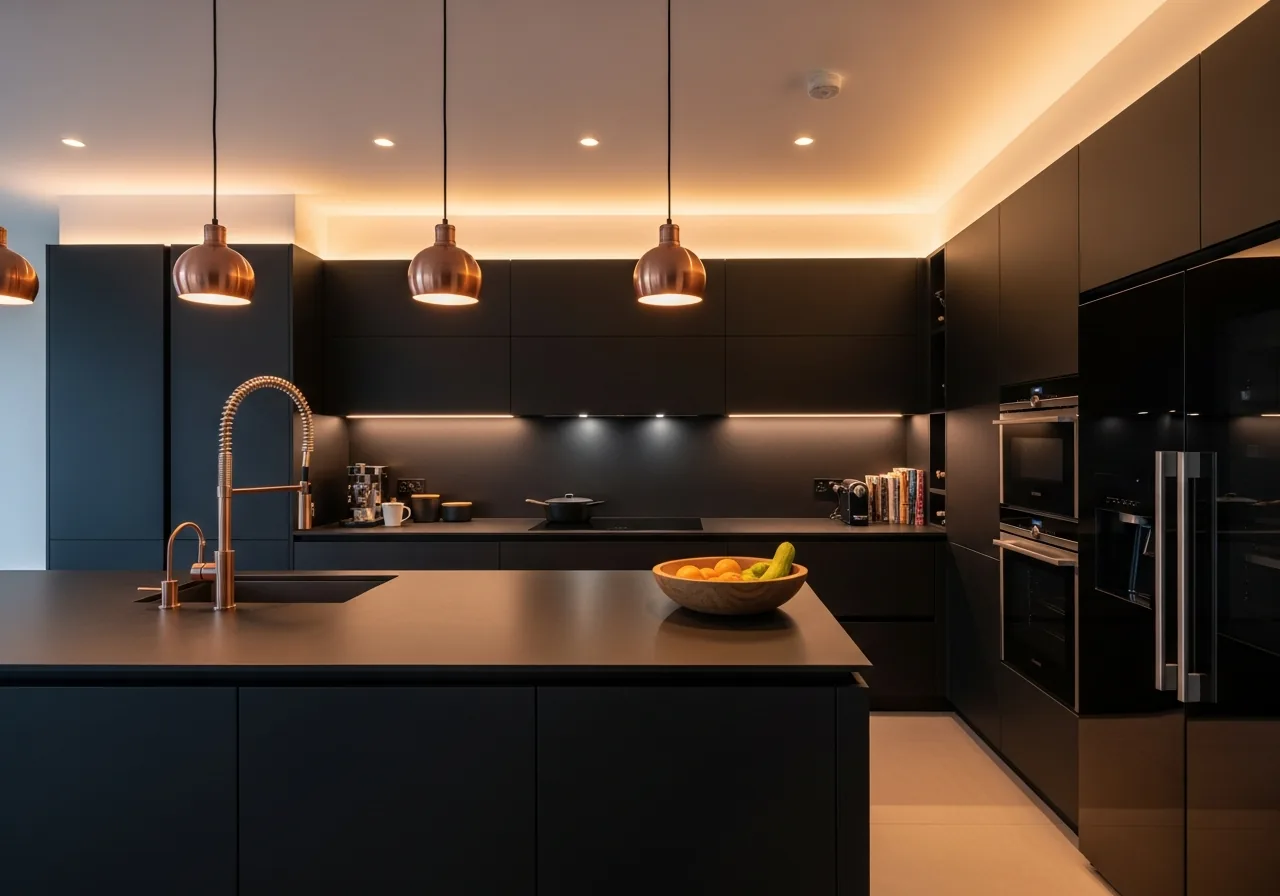
Under-cabinet lighting is probably the most functional lighting you will install in your kitchen. It illuminates the work surface directly, reducing shadows and making food preparation safer and more enjoyable. In a demonstration, you can see the difference between a strip that runs the full length of the cabinet and one that only covers part of it. You can also test the beam angle to make sure the light reaches the back of the counter, not just the front edge.
Recessed lighting, often called downlights, is the standard choice for general ambient light in modern kitchens. But the placement matters enormously. Too far apart and you get dark spots. Too close together and the ceiling looks like a grid. In a showroom, the recessed lights are already positioned correctly, so you can see what proper spacing looks like. You can also compare different trims and finishes to see how they blend with the ceiling.
Pendant Lights and Accent Lighting for Character
Pendant lights are where you can add personality to the kitchen. They hang over islands or breakfast bars and become a focal point. But pendant lights also need to be the right size and height for the space. In a kitchen lighting demonstration, you can see how a large pendant looks above a wide island and how a cluster of smaller pendants can create a more intimate feel. You can also test the light distribution to make sure the pendants provide enough task light for the island without blinding you when you sit down.
Accent lighting is the layer that brings the kitchen to life. It can be a strip of LED lights under the toe kick of the cabinets, a picture light above a piece of art, or a small spotlight aimed at a textured tile wall. Accent lighting is not strictly necessary, but it transforms a functional room into a beautiful one. In a demonstration, you can see how the accent lights interact with the ambient and task layers. You can decide whether you want them on a separate switch or tied into the main dimmer system.
Practical Tips for Your Showroom Visit
When you go for a kitchen lighting demonstration, go prepared. Bring samples of your cabinet door, worktop, and splashback if you have them. Ask to see the lights at full brightness and at dimmed levels. Spend time in the space moving around, opening drawers, and pretending to cook. Notice how the light feels on your eyes after ten minutes. And do not be shy about asking for the colour temperature to be changed. A good showroom will have the ability to switch between different LEDs so you can compare.
The best kitchens I have worked on have all started with a proper lighting plan, and that plan always began with a demonstration. It is an investment of an hour that saves you from years of regret. Whether you are choosing between British design cabinetry and German kitchens, or deciding between Kichler and Hinkley Lighting, the demonstration is where you get the answers. It is where theory becomes reality and where you finally understand why lighting design is not just about fixtures, but about how you live in the space.
So before you sign off on that kitchen renovation, book a kitchen lighting demonstration. Take the time to see the light, feel the light, and understand what you are buying. Your future self will thank you every time you step into that room.